Variant Equivalence
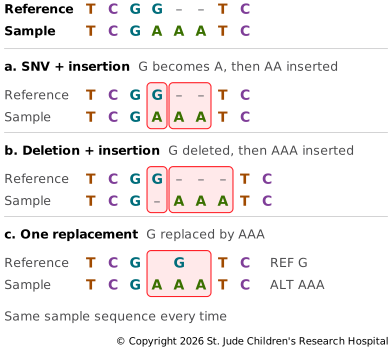
A variant records how a sample differs from the reference, and there's often more than
one correct way to write it. Say the reference reads TCGGTC and the sample reads
TCGAAATC. That could be a G changed to A, followed by an AA insertion. It could be the G
deleted and AAA inserted. Or it could be a single replacement of G with AAA, written in
a VCF file as REF G, ALT AAA. All
three describe the same physical reality, and two tools can easily pick different ones.
Many Ways to Write One Change
Three situations account for most of the differences:
- Position in a repeat. As the Indels page showed, deleting one CA from TCACACAG gives the same result whichever CA you remove. VCF tools left-align, placing the deletion at the first CA, positions 2–3. Variant names written in HGVS nomenclature, widely used in clinical reports and papers, do the opposite, assigning the change to the most 3′ position possible, here the last CA at positions 6–7. The same deletion can sit at two positions in a VCF file and in an HGVS name.
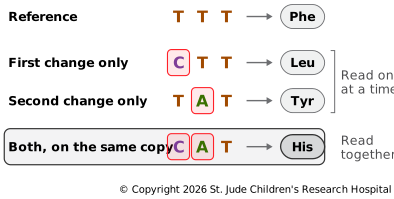
- Split or merged. Changes close together can be written as one event or several. Inside a codon, that changes the meaning. TTT codes for phenylalanine. Change the first base and you get CTT, leucine; change the second and you get TAT, tyrosine. Change both on the same copy and you get CAT, histidine, which neither change predicts alone. Across gnomAD, 18,756 nearby pairs of variants had a combined effect on the protein that differed from reading them one at a time. HGVS writes changes less than two bases apart as a single replacement, called a delins, while many variant callers report them separately.
- Structural variants. Breakpoints from short reads are often uncertain by a few
bases or more, and a deletion can be written out base by base or with a placeholder
such as
<DEL>plus an end position. Two calls of the same SV rarely match exactly, so they're compared by position, size and sequence within a tolerance. Too loose a tolerance merges different SVs; one study found that over-merging made SVs look up to 2.2 times as common as they were.
Why It Matters
Differences in how variants are written rarely change the biology, but they break comparisons:
- Comparing call sets. When two callers find the same variant but write it differently, a naive comparison counts one false positive and one false negative instead of a match. That makes callers look worse than they are and benchmarks unreliable.
- Looking variants up. Searching gnomAD or ClinVar with a different description of a known variant can come back empty, and a variant already reported as harmful can be missed.
- Combining samples. The same variant written two ways becomes two rows. Inconsistent representation magnifies the differences between tools and complicates filtering and removing duplicates.
Making Descriptions Match
No single fix covers every case, so analyses combine a few:
- Normalization. Rewrite every record the same way: left-align it, trim bases the
reference and sample share, and split records listing several alternative alleles into
one per allele. Tan and colleagues defined a normalized variant as one that's
left-aligned and as short as possible, and tools such as
bcftools normandvt normalizedo this. Normalization fixes the repeat problem, but it doesn't merge separate records, so the three descriptions of TCGAAATC above still won't match. - Comparing sequences. Benchmarking tools such as
hap.pyandvcfevalapply each set of variants to the reference and compare the sequences that result. If both produce TCGAAATC, they match, however they were written. The Global Alliance for Genomics and Health (GA4GH) recommends this approach for benchmarking small variants. - Computed identifiers. GA4GH's Variation Representation Specification (VRS) gives each variant an identifier computed from the variant itself, so the same variant gets the same identifier wherever it's described. To deal with repeats, VRS doesn't pick a left or right end. It expands the variant over the entire region of ambiguity, so the CA deletion above becomes a change to the whole CACACA stretch.
Up Next
Every method in this chapter starts from reads, short stretches of a sample's DNA read by a sequencer and placed on the reference. Next-Generation Sequencing covers where reads come from, from collecting a sample to choosing what to sequence and how.