Noncoding RNAs
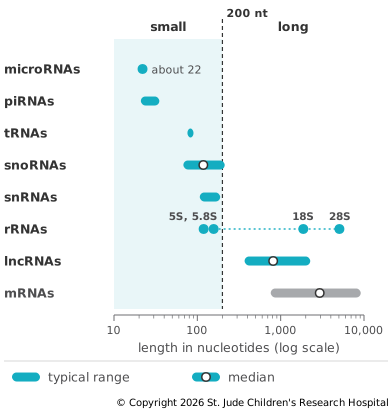
In The Central Dogma, genes are copied into RNA, and the RNA is translated into protein. Many RNAs skip the last step and do their work as RNA. These noncoding RNAs are usually sorted by length. Those longer than 200 nucleotides (nt) are called long noncoding RNAs, and the rest are called small (Mattick et al., 2023). As that review notes, the cutoff was chosen arbitrarily, because 200 nt is a convenient size limit in the lab methods used to purify RNA. Figure 7.6 shows how long each kind usually is. This page covers the main kinds, how they're measured and how they turn up in cancer.
The RNAs That Run the Cell
Some noncoding RNAs are part of the basic machinery that every cell needs.
Ribosomal RNA (rRNA) makes up most of a cell's RNA, which is why RNA-seq removes it first. A human ribosome is built from two subunits and four rRNAs. The small subunit holds the 18S rRNA, and the large subunit holds the 28S, 5.8S and 5S rRNAs. The 18S, 5.8S and 28S rRNAs are all cut from one long precursor RNA, and 5S is made from separate genes (Henras et al., 2015). The rRNA does more than hold the ribosome together. When the structure of the large subunit was solved in a microbe that lives in very salty water, the spot where amino acids are joined into a protein turned out to be made entirely of RNA, with no protein within about 18 ångströms (Nissen et al., 2000). An RNA that speeds up a chemical reaction is called a ribozyme, and the ribosome is one.
Transfer RNAs bring each amino acid to the ribosome. Most are 76 to 90 nt long (Berg and Brandl, 2021).
Small nuclear RNAs (snRNAs) are the RNA inside the spliceosome. The main spliceosome is assembled from five snRNAs, U1, U2, U4, U5 and U6, each bound to proteins, with U4 and U6 paired together. The snRNAs find the splice sites partly by pairing with them. One of the first steps in splicing is U1 snRNA pairing with the 5′ splice site at the start of an intron (Will and Lührmann, 2011).
Small nucleolar RNAs (snoRNAs) work in the nucleolus, the part of the nucleus where ribosomes are built, as Henras et al. describe. Many of them help make small chemical changes to other RNAs, mostly rRNAs and snRNAs. Each of these snoRNAs carries an enzyme to one spot on its target RNA, which it finds by pairing with the bases there. The enzyme then changes a single nucleotide at that spot. Some snoRNAs bring an enzyme that adds a methyl group. Others bring one that turns a uridine into pseudouridine, a rearranged form of the same base (Bratkovič et al., 2020).
MicroRNAs
MicroRNAs are about 22 nt long, and they turn down other genes by pairing with their mRNAs (Bartel, 2018). Each one starts out as part of a much longer RNA that folds back on itself into a hairpin, and it takes two cuts to free it (Figure 7.7). In the nucleus, an enzyme called Drosha, working with a partner protein called DGCR8, cuts the hairpin out of the long RNA. The hairpin, about 70 nt at this stage (Lee et al., 2003), is carried out to the cytoplasm, where an enzyme called Dicer cuts off the loop. That leaves a short double-stranded piece about 20 base pairs long. One strand, the mature microRNA, is loaded into a protein called Argonaute, and the other strand is broken down.
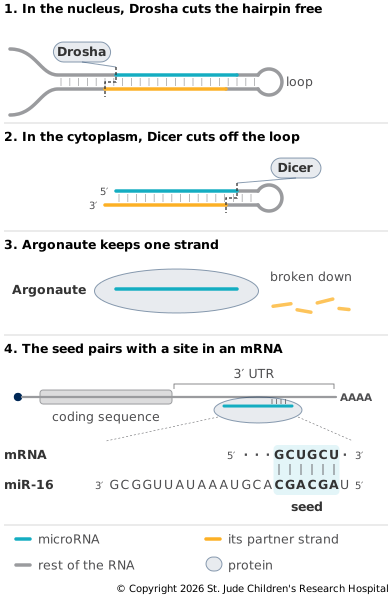
Inside Argonaute, the microRNA works as a guide. Its key part is the seed, nucleotides 2 to 7 counted from its 5′ end, which pairs with matching sites in mRNAs, mostly in their 3′ UTRs, as Bartel's review explains. Once Argonaute is bound, the mRNA makes less protein, mainly because the mRNA is broken down faster. In one study, lower mRNA levels accounted for at least 84% of the drop in protein (Guo et al., 2010).
A six-letter seed can match many genes, so each microRNA has many targets. When a single microRNA was added to human cells, about 100 mRNAs dropped within 12 hours (Lim et al., 2005). Two studies that measured proteins directly found that one microRNA lowered hundreds of proteins, most of them only a little (Selbach et al., 2008; Baek et al., 2008). Across the genome, more than 60% of human protein-coding genes have kept sites that pair with microRNAs over the course of evolution (Friedman et al., 2009). MicroRNAs with the same seed are grouped into a seed family, and members of a family often do overlapping jobs, as Bartel's review notes.
A second group of small RNAs works the same way. PIWI-interacting RNAs (piRNAs) are 21 to 35 nt long and guide PIWI proteins, a branch of the Argonaute family (Höck and Meister, 2008). Their main job is in the germ line, the cells that give rise to eggs and sperm, where they silence transposons, stretches of DNA that can copy themselves into new places in the genome (Ozata et al., 2019).
Long Noncoding RNAs
Long noncoding RNAs (lncRNAs) are the biggest group. GENCODE lists more lncRNA genes than protein-coding genes, as you'll see in Try It below. Most are made by the same RNA polymerase that makes mRNA, and many are spliced and given a 5′ cap and a poly-A tail, just as mRNAs are, though some aren't, as Mattick's review notes. A few have well-understood jobs:
- XIST silences one of the two X chromosomes in female cells, the X inactivation mentioned in Epigenetic Modifications. It's made only from the X chromosome that will be silenced (Brown et al., 1991), it spreads along that same chromosome and coats it (Clemson et al., 1996), and X inactivation can't happen without it (Loda and Heard, 2019).
- NEAT1 is the scaffold of paraspeckles, small bodies in the nucleus (Clemson et al., 2009). Mice without NEAT1 live and breed normally in the lab and lose only their paraspeckles (Nakagawa et al., 2011), though a later study found that some of the females fail to become pregnant (Nakagawa et al., 2014).
- Telomerase RNA is part of telomerase, the enzyme that rebuilds the ends of chromosomes. At 451 nt, it's long enough to count as a lncRNA (Klump and Schmidt, 2023). The core of the enzyme is this RNA plus a protein called TERT (Nguyen et al., 2018). Eleven of its bases, CUAACCCUAAC, form the template that telomerase copies to add TTAGGG repeats to chromosome ends (Feng et al., 1995).
Most lncRNAs look quite different from mRNAs in sequencing data. They're usually made at lower levels and in fewer tissues, and their exons change faster over evolution than protein-coding exons, though more slowly than old repeated DNA thought to have no function. Some of that tissue specificity may come from their low levels, which make them easy to miss in tissues where they are made (Derrien et al., 2012). In one catalog of lncRNAs found between genes, 78% were specific to a tissue, against about 19% of protein-coding genes (Cabili et al., 2011).
How many lncRNAs have a real job is still argued over. Mattick's review counts about 50,000 papers on lncRNAs, more than 2,000 of them reporting a tested function, though most of those functions haven't been followed up in detail. Others argue that most lncRNAs are noise from transcription or play only minor roles (Ponting and Haerty, 2022). Sometimes a lncRNA gene does its job without needing the RNA at all. In a study of 12 lncRNA loci in mouse cells, 5 changed the activity of a neighboring gene, and none of those effects needed the lncRNA. They came from the act of transcription, from splicing, or from the lncRNA's promoter acting like an enhancer (Engreitz et al., 2016). Even a skeptic's estimate leaves plenty to study. As Palazzo and Lee put it, "even if 10% of current lncRNAs prove to be functional, this would represent a wealth of new biology" (Palazzo and Lee, 2015).
Splicing can also close an RNA into a loop. In back-splicing, the end of an exon is joined to the start of an earlier exon, making a circular RNA. With no free ends, a circular RNA has no 5′ cap or poly-A tail (Patop et al., 2019).
Measuring Them
How a library is made decides which noncoding RNAs it can see. As RNA-seq describes, poly-A selection loses RNAs without a tail, such as circular RNAs and some lncRNAs, and total RNA-seq keeps them.
MicroRNAs and other very short RNAs need their own method. In standard RNA-seq, they're too short to be copied reliably and are lost when fragments are selected by size. Small RNA-seq attaches adapters directly to both ends of each small RNA before copying it into DNA (Sun and Chen, 2020). Some kits add a poly-A tail to each small RNA in place of one adapter. Most start from all of a sample's RNA, and the short inserts are selected by size after the adapters are added (Benesova et al., 2021).
Noncoding RNAs in Cancer
MicroRNAs Lost in Leukemia
Chronic lymphocytic leukemia (CLL) is a cancer of B cells, a type of white blood cell. A region of chromosome 13 called 13q14 is deleted in more than half of CLL cases. Calin et al. found two microRNA genes in this region, MIR15A and MIR16-1, and found them deleted or turned down in about 68% of cases (Calin et al., 2002). Their microRNAs, miR-15a and miR-16, lower Bcl-2, a protein that keeps cells from dying, and restoring them made leukemia cells die in a lab model (Cimmino et al., 2005). Bcl-2 is the relative of Bcl-xL from Alternative Splicing. Mice missing the stretch of 13q14 that holds both microRNAs developed the range of B cell disorders seen in human CLL, and losing the two microRNAs made B cells divide faster (Klein et al., 2010).
DICER1 and Childhood Tumors
Inherited loss-of-function variants in DICER1, the gene for Dicer, predispose children to pleuropulmonary blastoma (PPB), a rare lung tumor. Hill et al. found them in 11 families with PPB (Hill et al., 2009). The tumors follow the two-hit pattern in their own way. In 15 tumors studied, every one had a variant that broke one copy of DICER1, inherited in 12 and acquired in the tumor in 3. Each also had an acquired change that swapped one amino acid in one of Dicer's two cutting regions (Pugh et al., 2014). People who inherit a DICER1 variant can also develop other tumors, including Sertoli–Leydig cell tumors of the ovary, cystic nephroma of the kidney and thyroid nodules. The risk is highest in early childhood, and the variants are inherited in an autosomal dominant pattern with reduced penetrance, so many people who carry one never develop a tumor (Schultz et al., 2018).
A Spliceosome RNA in Medulloblastoma
Medulloblastoma is a brain tumor, and one group of these tumors is named for the Sonic hedgehog (SHH) signaling pathway that drives them. About half of SHH medulloblastomas carry the same mutation in U1 snRNA, an A changed to G at its third base. It's found in 97% of adults with this kind of tumor and 25% of adolescents, but it's largely absent in infants (Suzuki et al., 2019). That base sits in the part of U1 that pairs with the 5′ splice site, so the mutant U1 picks out new cryptic splice sites. As Suzuki et al. found, the changed splicing switches off the tumor suppressor PTCH1 and switches on the oncogenes GLI2 and CCND2. A different change at the same base, A to C, turns up in other cancers, including about 4% of CLL and about 6% of liver cancers (Shuai et al., 2019; Niño et al., 2022).
Setting Up
This page uses samtools and curl, as in Setting
Up in From Reads to Variants. If you
made the reads-to-variants or file-formats environment, activate it with conda activate reads-to-variants or conda activate file-formats. Otherwise, follow Install
the Tools on that
page. The files on this page take up about 250 MB.
Try It
Make a folder, download the GENCODE annotation from GTF/GFF3 Files, and save its gene lines to a smaller file:
# Make a folder for this page and move into it
mkdir ncrna && cd ncrna
# Download the GTF file for GENCODE release 50
curl -fLO https://ftp.ebi.ac.uk/pub/databases/gencode/Gencode_human/release_50/gencode.v50.annotation.gtf.gz
# Save the gene lines to their own file
gunzip -c gencode.v50.annotation.gtf.gz | awk -F '\t' '$3 == "gene"' > genes.gtf
# Count the genes of each kind of RNA on this page, with protein-coding genes for comparison
grep -o 'gene_type "[^"]*"' genes.gtf | grep -E '"(protein_coding|lncRNA|miRNA|snRNA|snoRNA|rRNA|Mt_tRNA|Mt_rRNA)"' | sort | uniq -c | sort -rn
34866 gene_type "lncRNA"
20107 gene_type "protein_coding"
1901 gene_type "snRNA"
1878 gene_type "miRNA"
 985 gene_type "snoRNA"
  47 gene_type "rRNA"
  22 gene_type "Mt_tRNA"
   2 gene_type "Mt_rRNA"
There are about 35,000 lncRNA genes, against about 20,000 protein-coding genes. Two kinds of RNA from this page are thin on the ground. The only tRNA genes here are the 22 in the mitochondrial genome, because GENCODE keeps its predicted nuclear tRNA genes in a separate file (GENCODE release 50). And none of the 47 rRNA genes is an 18S or 28S gene:
# Count the rRNA genes named 18S or 28S
grep 'gene_type "rRNA";' genes.gtf | grep -c '18S\|28S'
0
The 18S and 28S genes sit in long arrays of repeated copies, called rDNA, that the GRCh38 reference genome leaves as unknown sequence (Nurk et al., 2022).
Next, find the two microRNA genes from 13q14:
# Show the position, strand and name of MIR15A, MIR16-1 and DLEU2
grep -E 'gene_name "(MIR15A|MIR16-1|DLEU2)";' genes.gtf | awk -F '\t' '{split($9, a, ";"); print $1, $4, $5, $7 a[3]}'
chr13 49956669 50126118 - gene_name "DLEU2"
chr13 50048973 50049061 - gene_name "MIR16-1"
chr13 50049119 50049201 - gene_name "MIR15A"
MIR15A and MIR16-1 sit about 60 bases apart, and both fall inside DLEU2, a lncRNA gene, on the same strand. Each microRNA gene here is only 80 to 90 bases long, about the size of the hairpin. To see their sequences, download chromosome 13 of the reference:
# Download chromosome 13 of GRCh38 from UCSC
curl -fLO https://hgdownload.soe.ucsc.edu/goldenPath/hg38/chromosomes/chr13.fa.gz
# Decompress it to chr13.fa
gunzip chr13.fa.gz
# Index it so tools can jump to any position
samtools faidx chr13.fa
# Read both hairpins on the - strand, each on one line
samtools faidx -i -n 100 chr13.fa chr13:50048973-50049061 chr13:50049119-50049201
>chr13:50048973-50049061/rc
GTCAGCAGTGCCTTAGCAGCACGTAAATATTGGCGTTAAGATTCTAAAATTATCTCCAGTATTAACTGTGCTGCTGAAGTAAGGTTGAC
>chr13:50049119-50049201/rc
CCTTGGAGTAAAGTAGCAGCACATAATGGTTTGTGGATTTTGAAAAGGTGCAGGCCATATTGTGCTGCCTCAAAAATACAAGG
Both genes are on the - strand, which means their RNA is copied from the opposite
strand to the one the reference spells out. The -i option turns each region around and
swaps every base for its partner, so you see the sequence the way the RNA reads, from 5′
to 3′. Alternative Splicing uses the same option. -n 100 keeps each sequence on one line. The reference is DNA, so it shows T where the RNA
has U.
Each sequence folds back on itself to form a hairpin, so stretches in its first half pair with stretches in its second half. In the first hairpin, bases 15 to 22 read AGCAGCAC, and bases 68 to 75 read GTGCTGCT. Write the second stretch backward under the first, and every base lines up with its partner, A with T and G with C:
bases 15 to 22            5′ AGCAGCAC 3′
                             ||||||||
bases 68 to 75, backward  3′ TCGTCGTG 5′
As you'll see below, bases 15 to 22 are part of miR-16, and bases 68 to 75 are part of its partner strand, as in step 1 of Figure 7.7.
miRBase, a catalog of microRNAs, lists miR-16 as UAGCAGCACGUAAAUAUUGGCG (miRBase MIMAT0000069) and miR-15a as UAGCAGCACAUAAUGGUUUGUG (miRBase MIMAT0000068). Each starts at the 14th base of its hairpin. Read just those 22 bases:
# Read the mature miR-16 and miR-15a
samtools faidx -i chr13.fa chr13:50049027-50049048 chr13:50049167-50049188
>chr13:50049027-50049048/rc
TAGCAGCACGTAAATATTGGCG
>chr13:50049167-50049188/rc
TAGCAGCACATAATGGTTTGTG
The two microRNAs differ after their ninth base, but they share their seed, AGCAGC at positions 2 to 7, so both belong to the miR-15/16 seed family and can pair with the same sites. The first is the miR-16 in Figure 7.7, where it's written backward, from 3′ to 5′.
That's the end of this exercise. Move out of the folder and delete it:
# Move up out of the folder
cd ..
# Delete the folder and everything in it
rm -r ncrna