Inherited Risk
Most of the mutations behind a cancer arise during a person's lifetime, in the cells that become the tumor. Some people, though, start life with a germline variant that raises their risk of cancer. A variant passed down in an egg or sperm is in every cell of the body. One that arises after fertilization is passed only to the cells that descend from the cell where it arose. Having cells with different genomes in one body is called mosaicism, and it can start in the first days of development or later (National Human Genome Research Institute). About 5–10% of all cancers are thought to be caused by harmful variants inherited from a parent (National Cancer Institute).
Such a variant creates a predisposition to cancer. It raises the odds, and some carriers never develop cancer at all. How likely a carrier is to develop the disease is the variant's penetrance, and it differs widely from gene to gene.
The Second Hit
Most of the genes behind inherited risk are tumor suppressors. As Two Hits explained, many tumor suppressors stop holding a cell back only when both copies are lost. A person who inherits one broken copy starts with every cell one step along, and a tumor often begins when one of those cells loses the working copy. In tumors from 10,389 adults with 33 kinds of cancer, 8% of patients carried a germline variant that predisposed them to cancer. In tumor suppressors, 43% of these variants showed signs of a second hit in the tumor, usually loss of the working copy. A smaller number were in oncogenes such as MET and RET, and these genes tended to be more highly expressed (Huang et al., 2018).
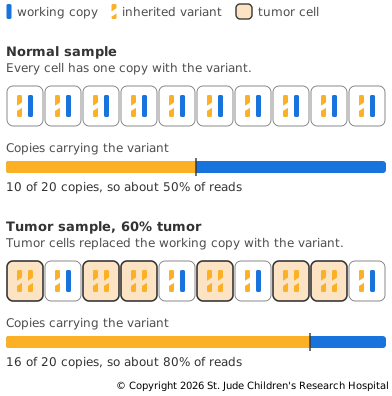
The second hit leaves a mark in sequencing data. In a normal sample from a carrier, each cell has two copies of the gene, one with the variant and one that works. Reads come from both copies about equally, so roughly half of the reads at that position show the variant. The share wobbles a little above or below 50% by chance, and it can be well below 50% when the variant is mosaic. One way a tumor loses the working copy is copy-neutral loss of heterozygosity, which replaces it with a second copy of the broken one. Every read from a tumor cell then shows the variant, and in a sample that is 60% tumor, about 80% of all reads do (Figure 2.10).
Well-Known Syndromes
A predisposition that runs in families and follows a recognizable pattern is called a hereditary cancer syndrome. A few are especially well studied. In most of them, a person is born with one broken copy of a gene in every cell, and the other copy still works. Constitutional mismatch repair deficiency is the exception, because it starts with two broken copies.
- Li-Fraumeni syndrome (TP53). Carriers develop many kinds of cancer, often young, including breast cancer, sarcomas and brain tumors. In 286 carriers, half of the women had developed cancer by age 31 and half of the men by 46, and nearly all by age 70. About half of those who had one cancer went on to develop another (Mai et al., 2016).
- Hereditary breast and ovarian cancer (BRCA1 and BRCA2). Among nearly 10,000 women who carried a variant in one of these genes, the risk of breast cancer by age 80 was 72% for BRCA1 and 69% for BRCA2. The risk of ovarian cancer was 44% and 17% (Kuchenbaecker et al., 2017).
- Lynch syndrome (MLH1, MSH2, MSH6 and PMS2). These are mismatch repair genes, and about 1 in 279 people carries a harmful variant in one of them (Win et al., 2017). The risk depends on the gene. Carriers of MLH1 and MSH2 variants have high risks of colorectal, endometrial and ovarian cancer, MSH6 variants mainly raise the risk of endometrial cancer, and a large study found no clear rise in risk for PMS2 (Dominguez-Valentin et al., 2020).
- Constitutional mismatch repair deficiency. A child who inherits a broken copy of the same mismatch repair gene from both parents has no working copy in any cell. Cancers start in childhood, mainly in the blood, the brain and the intestines (Wimmer et al., 2014).
- Heritable retinoblastoma (RB1). This is the case that led to the two-hit model. About 25–30% of retinoblastomas are heritable, but only about a quarter of these children have a parent who had the disease. In the rest, the RB1 variant arose new, in a sperm or egg cell or early in development (National Cancer Institute). Because every cell carries the broken copy, the risk doesn't end with the eye. Among 1,128 survivors of heritable retinoblastoma, 33.1% had developed another cancer within 50 years, with especially high risks of sarcomas and raised risks of melanoma and breast cancer. Survivors of the nonheritable form showed no rise in risk (Schonfeld et al., 2021). In one study of survivors of the heritable form, those who'd had radiation treatment for the eye tumor had about three times the risk of these later cancers (Kleinerman et al., 2005).
Predisposition in Childhood Cancer
In children with cancer, these variants are more common than once thought. When the genomes or exomes of 1,120 children and adolescents with cancer were sequenced, 8.5% carried a germline variant judged harmful in a predisposition gene, compared with 1.1% of people without known cancer. TP53 was by far the most common, in 50 patients, followed by APC, BRCA2, NF1, PMS2, RB1 and RUNX1. Of the 58 carriers whose family history was known, only 23 (40%) had relatives with cancer (Zhang et al., 2015). A later study found more. In 309 children sequenced at diagnosis or relapse, 18% carried a variant that predisposed them to cancer, and the tumor data suggested a role in the tumor for 55% of the harmful germline variants (Newman et al., 2021).
Why would most of these children have no relatives with cancer? The variant's penetrance may be low, or the variant may be new. Among 336 people with Li-Fraumeni syndrome, at least 14% of the TP53 variants had arisen new in the person, and the authors estimate that about a fifth of these arose during embryonic development, leaving a mosaic variant carried by only some of the body's cells (Renaux-Petel et al., 2018).
Common Variants, Small Effects
The variants above are rare, and many of them raise risk sharply. Inherited risk also comes from many common variants that each raise it a little. These are found by genome-wide association studies, and their small effects can be added up into a polygenic risk score. A score built from 313 variants, using data from women of European ancestry, gave the 1% of women with the highest scores an estimated lifetime risk of breast cancer of 32.6% (Mavaddat et al., 2019).
Finding Them in the Data
An inherited variant shows up in a tumor's data, where it can look like a change that arose in the tumor. The clearest way to tell the two apart is to sequence a matched normal alongside the tumor. In 815 patients with 15 kinds of cancer, the matched normal revealed germline variants in predisposition genes in 3% of patients whose cancers showed no sign of being inherited. Without it, the analysis couldn't tell for certain which changes in these genes were inherited, and it added false findings that made up 31% of the changes in a targeted panel and 65% in exomes (Jones et al., 2015).
An inherited variant can be relevant to a patient's cancer, and their relatives may carry it too. Studies have compared testing every patient with testing only those whose cancer or family history points to an inherited cause. Among 2,984 adults with cancer who were all tested, whatever their cancer type, age or family history, 13.3% carried a harmful germline variant. In 6.4%, the variant wouldn't have been found under the usual criteria for deciding who to test (Samadder et al., 2021).
Researchers have also followed carriers over time. In a study of 89 carriers from families with Li-Fraumeni syndrome, 59 had regular scans and tests at some point, which found 40 tumors in 19 of them before the tumors caused symptoms (Villani et al., 2016).
Up Next
This chapter followed cancer from the genes that drive it to the ways a tumor changes as it grows. The rest of this guide is about finding those changes in data. Genomic Variation starts with the kinds of variants you'll find and the baselines they're measured against.