Read Mapping
Sequencing leaves you with something like a box of puzzle pieces dumped out on a table. Each read is one piece, and nothing on it says where it belongs. Putting each piece back in its place is called read mapping, or alignment. As with any puzzle, it helps to have the picture on the front of the box, and in genomics that picture is the reference genome. The picture isn't a perfect match, though. Your genome differs from the reference in millions of places, and those differences are what this chapter is looking for. And some parts of the picture, like a stretch of clear sky, look the same in many places, so a piece from there could fit in more than one spot.
Choosing a Reference
Before mapping, you decide which reference to use. Here it's chromosome 20 of GRCh38, which you downloaded on Setting Up. Every step after this one depends on that choice. The same position has different coordinates in different versions of the reference, so results from two versions can't be compared directly (see Baselines for Variation). Moving an analysis to a new version means mapping every sample again, so a project usually stays on the version it started with. GRCh38 was the first update to change coordinates since GRCh37, released in 2009 (Schneider et al., 2017), and both are still in use. Genome in a Bottle, for example, publishes its newest truth set for GRCh37 as well as GRCh38.
How an Aligner Works
The software that does the mapping is called a mapper or aligner. It starts by building an index of the reference, a lookup table of short sequences and where each one occurs. For every read, it looks up short exact matches, called seeds, to find the places the read might belong. It then lines up the whole read at each of those places, allowing for mismatches, insertions and deletions, and keeps the best (Li, 2018). For paired reads, it maps both reads of a pair together and expects them to land a fragment's length apart, facing each other (see Paired-End Reads). Aligners have many settings that can be tuned to the kind of data.
BWA (Li and Durbin, 2009) has long been a standard choice for short DNA reads. This chapter uses minimap2, from the same author, which is three to four times as fast as the usual short-read aligners at comparable accuracy and also handles long reads (Li, 2018). RNA needs a different kind of aligner. A read from a spliced mRNA can span two exons that sit far apart in the genome (see Transcription), so RNA-Seq reads are mapped with a splice-aware aligner such as STAR (Dobin et al., 2013).
What the Aligner Records
The aligner writes its results in SAM (Sequence Alignment/Map) format: plain text, with one line per read and the details in tab-separated columns (SAM specification). Text is simple for any program to write and read, which is why aligners produce it, but it takes up a lot of space. Pipelines therefore usually store alignments as BAM, the same records compressed into a binary form (see SAM/BAM/CRAM Files). A BAM file is several times smaller, and once it is sorted it can be indexed, so tools can jump straight to one region instead of reading the whole file. Nearly every analysis after this point starts from a BAM file.
For each read, the aligner records where the read landed, how it lines up there and how
sure the aligner is. Where it lines up is written as a CIGAR string, a short code
that counts bases in runs. 148M means all 148 bases are aligned to the reference,
matching or not; I marks bases inserted relative to the reference, D bases deleted
from it and S bases left out of the alignment (SAM
specification).
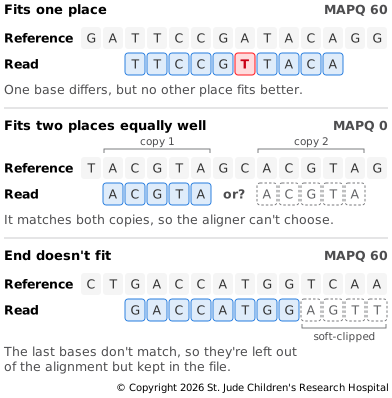
How sure the aligner is goes in the mapping quality, or MAPQ. Like a base quality score (see Quality Scores), it is on the Phred scale: MAPQ is −10 log10 of the chance that the position is wrong, so 60 means about a one in a million chance (SAM specification). It is the aligner's own estimate, and each aligner works it out differently. minimap2 reports values from 0 to 60. A read that fits two or more places equally well, such as a read from inside a repeat, gets a MAPQ of 0. The aligner still reports one of the places, but it has no way of knowing which is right. A read pair can sometimes settle it, because a mate in unique sequence nearby shows which copy the pair came from.
Variant callers give reads with low mapping quality little or no weight, so variants in repeated sequence are easy to miss. One study of standard short-read data found stretches of 748 genes, inside protein-coding exons, that either had too few reads that mapped or had reads that couldn't be placed with confidence (Ebbert et al., 2019). Long reads, which can span a repeat, resolved most of them.
Sometimes the end of a read doesn't fit anywhere near where the rest of it lines up. It might be leftover adapter, or the read might cross the breakpoint of a structural variant. Rather than force a poor alignment, the aligner soft-clips the end: the bases stay in the file, but they're left out of the alignment. minimap2 can then map the clipped part on its own, somewhere else, as a supplementary alignment (Li, 2018).
Try It
This step needs chr20.fa, reads_1.fq.gz and reads_2.fq.gz from Setting
Up. Run it from the same folder, with the reads-to-variants
environment active:
# Map each read pair to chromosome 20, then save the alignments as a BAM file
minimap2 -ax sr -t 4 chr20.fa reads_1.fq.gz reads_2.fq.gz \
  | samtools view -b -o hg002.mapped.bam -
-x sr loads minimap2's settings for short reads, -a asks for full alignments in SAM
format and -t 4 uses four processor cores. minimap2 builds its index of chr20.fa
first, which for one chromosome takes a few seconds. It then writes SAM text, and the
| (a pipe) passes that text straight to samtools view -b, which compresses it into
hg002.mapped.bam. The SAM text is never saved to disk. As SAM, these alignments would
take about 190 MB; as BAM, they take 57 MB. On our computer, the whole step took about
four seconds and less than 1 GB of memory.
Then ask samtools for a summary:
# Count how the reads mapped
samtools flagstat hg002.mapped.bam
Among its output are these lines:
415831 + 0 in total (QC-passed reads + QC-failed reads)
235 + 0 supplementary
412743 + 0 mapped (99.26% : N/A)
387086 + 0 properly paired (93.14% : N/A)
3084 + 0 singletons (0.74% : N/A)
The file holds 415,831 alignments: one for each of the 415,596 reads, plus 235 supplementary alignments for clipped parts mapped somewhere else. Over 99% of the reads mapped. 93% are properly paired, meaning both reads mapped facing each other at a distance that fits the library. Most of the rest mapped too, but sit 800 to 1,000 bases apart, farther than minimap2 expected from the typical pair here. The 3,084 singletons are reads that mapped while their mate didn't.
Next, look at the alignments themselves. samtools view prints a BAM file's records as
SAM text, and cut -f 1-6 keeps the first six columns:
# Show the first five alignments, keeping only the first six columns
samtools view hg002.mapped.bam | head -n 5 | cut -f 1-6
Each line is one alignment. Here is a made-up example of what one looks like:
read_1 99 chr20 10250312 60 140M8S
From left to right, the columns are (SAM specification):
read_1: the read's name, the same as in the FASTQ file.99: the flag, a number that packs several yes-or-no facts together. Each fact has its own value, and the flag is their sum. Here 99 is 1 + 2 + 32 + 64: the read is paired, the pair is properly paired, the mate is on the reverse strand and this is Read 1.chr20and10250312: the chromosome and the position of the first aligned base.60: the mapping quality.140M8S: the CIGAR string. The first 140 bases are aligned and the last 8 are soft-clipped.
Compare the example with your own output. Then count the reads that got a mapping quality of 0:
# Keep the mapped reads with a mapping quality of 0, then count them
samtools view -F 0x904 hg002.mapped.bam | awk '$5 == 0' | wc -l
-F 0x904 skips unmapped reads and extra alignments, so each read is counted once, and
the mapping quality is the fifth column. The answer is 99, out of 412,508 mapped reads.
That's very few, partly because the reference here is a single chromosome, so a read
whose other copies lie on other chromosomes has only one place to go (see Check What
You Have). Across the whole genome, the share
would be higher.
Next, get the alignments ready for variant calling: Preparing Alignments.