Whole-Exome Sequencing (WES)
Whole-exome sequencing (WES) reads only the exome, the exons of all known genes. That's a small slice of the genome, but it holds most of the variants known to cause disease by changing a protein, so for many questions it gives most of the answer for much less sequencing.
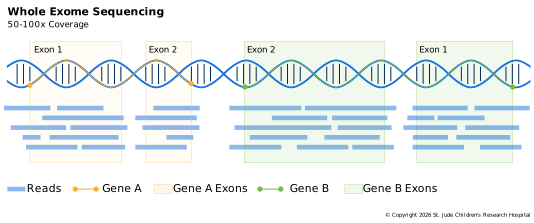
What It Measures
WES measures the sequence of protein-coding exons, about 1% of the genome (Ng et al., 2009). Commercial exome kits differ in exactly which exons they include, and most also cover some of the untranslated regions at each end of a gene.
How the Library Is Made
An exome library starts like a genome library, then adds a step called hybrid capture to keep only the exons. The library is mixed with short strands of RNA or DNA, called baits, that match the exons. Each bait carries a chemical tag, biotin, that sticks tightly to magnetic beads. Fragments from exons pair with the baits, the beads pull them out, and everything else is washed away (Gnirke et al., 2009). The original paper described it as using baits to "fish" targets out of a "pond" of DNA fragments.
Capture isn't perfect. Some fragments that don't match any bait come along anyway, so a share of reads land off target. Regions very rich in G and C capture poorly, leaving gaps in coverage (Sulonen et al., 2011).
Depth and Read Setup
Because the exome is so much smaller than the genome, the same number of reads covers it far more deeply than it would cover the whole genome. Exomes are usually sequenced paired-end. The first exome studies used around 40x (Ng et al., 2010). Clinical exomes go deeper: one clinical laboratory reported a mean of more than 130x (Yang et al., 2013). Coverage is less even than in a genome, so a high average still leaves some exons thinly covered.
Tradeoffs
Pros
- Coding variants. WES is good at finding SNVs and small indels in coding regions, which is where most disease-causing variants known today are.
- Depth. Because the exome is small, the same number of reads covers it far more deeply than a genome (see Depth and Read Setup).
Cons
It misses what it doesn't capture:
- Noncoding variants. Variants in promoters, enhancers and deep in introns aren't read at all.
- Most structural variants. Their breakpoints usually fall outside exons, where there are no reads.
- Copy number changes, mostly. Depth can still hint at large gains and losses, but capture adds its own unevenness, so the signal is noisier than in a genome.
- Poorly captured exons. Some exons, often those rich in G and C, get too few reads to call variants.
Example: The First Gene Found by Exome
Miller syndrome is a rare disorder that affects the face and limbs. In 2009, its cause was unknown. Researchers sequenced the exomes of four affected people from three families, to a mean depth of 40x (Ng et al., 2010). They removed variants already listed in public databases, then looked for a gene with two new variants in every patient, as expected for a recessive disease. Only one gene fit: DHODH, which makes an enzyme cells need to build some of the bases in DNA and RNA. Sanger sequencing found DHODH variants in three more families.
The authors described it as the first time exome sequencing had found the gene behind a rare inherited disease with an unknown cause (Ng et al., 2010). Within a few years, exomes were being used in clinics. In one clinical laboratory's first 250 patients, exome sequencing found a likely genetic cause in 25% (Yang et al., 2013).