Hallmarks of Cancer
Cancers start in different tissues, carry different mutations and behave in different ways, yet they share a handful of abilities. In 2000, Douglas Hanahan and Robert Weinberg proposed six capabilities that cells gain as a tumor develops, which they called the hallmarks of cancer (Hanahan and Weinberg, 2000). They updated the list in 2011, and Hanahan updated it again in 2022, when it reached eight hallmarks (Hanahan, 2022). Hanahan describes the scheme as a heuristic tool, a provisional way to organize a very complicated disease.
This page walks through the eight hallmarks, the two processes that help cells gain them and the ideas proposed most recently.
The Eight Hallmarks
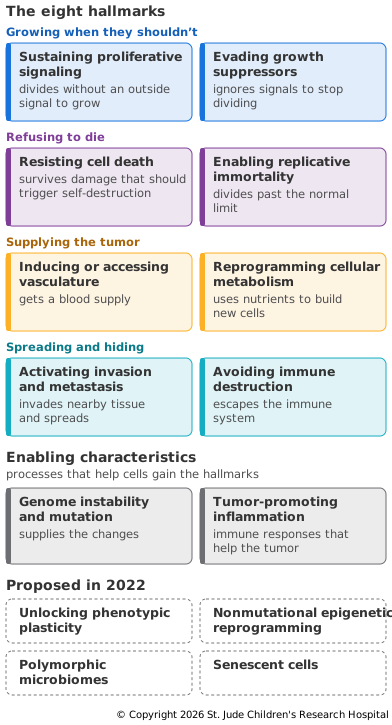
In this guide, we group the eight hallmarks into four pairs, based on what each pair lets a tumor do. The papers don't group them this way. Hanahan and Weinberg list each hallmark as a separate capability and draw them as equal parts of a wheel. In 2011 they set two of them apart as "emerging" hallmarks, and in 2022 Hanahan made those two full hallmarks like the rest (Hanahan, 2022). Our pairs are only an aid for organizing the information in this guide.
Growing When They Shouldn't
Normal cells grow only when they receive signals telling them to (National Cancer Institute). A cancer cell with the first hallmark, sustaining proliferative signaling, keeps dividing without waiting for those signals. The cell might make its own growth signal, or a protein that passes the signal along might be stuck in the "on" position. Signaling Pathways follows one of these relays from the cell surface to the nucleus.
Cells also receive signals telling them to stop. Normal cells, for example, stop growing when they run into other cells. A cell that is evading growth suppressors ignores these signals. Oncogenes and Tumor Suppressors covers the genes behind both hallmarks: the ones that push a cell to divide and the ones that hold it back.
Refusing to Die
A cell with damaged DNA or other serious problems normally destroys itself through a process called apoptosis, or programmed cell death. Cancer cells that are resisting cell death ignore the signals that would trigger it (National Cancer Institute).
Even a cell that keeps dividing eventually runs into a limit. The ends of each chromosome are capped by repeated sequences called telomeres, which get shorter as normal human cells divide, and this shortening is thought to limit how many times a cell can divide (Harley et al., 1990). An enzyme called telomerase rebuilds them. Telomerase was active in 90 of 101 tumor samples across 12 types of cancer, but in none of 50 samples of normal body tissue (Kim et al., 1994). Keeping their telomeres from running out removes one of the limits on how many times cells can divide. Cells that get past this and the other limits have gained replicative immortality. One way cancer cells keep telomerase on is easy to see in sequencing data. In one study, 71% of melanomas carried a mutation in the promoter of TERT, the gene for telomerase. In lab tests, these mutations made the promoter two to four times more active (Huang et al., 2013). These mutations sit outside the protein-coding sequence, a reminder that drivers are not limited to exons.
Supplying the Tumor
Like any tissue, a tumor needs blood vessels to bring oxygen and nutrients and to carry waste away. Cancer cells can signal blood vessels to grow toward the tumor (National Cancer Institute) or take over vessels that already supply normal tissue (Hanahan, 2022). This hallmark is called inducing or accessing vasculature. Some cancer treatments, called angiogenesis inhibitors, work by blocking the growth of new blood vessels that support the tumor (National Cancer Institute).
A tumor also has to build new cells, which takes raw materials as well as energy. Most normal cells that are not dividing get their energy by fully breaking down sugar in their mitochondria (Vander Heiden et al., 2009). Many cancer cells instead turn much of their sugar into lactate, even when there is plenty of oxygen. This process is called aerobic glycolysis, or the Warburg effect. It makes less energy from each sugar molecule, and cancer cells still use their mitochondria as well. Normal cells that are dividing quickly do the same thing. One explanation is that this way of using nutrients leaves more of them available to build the DNA, proteins and fats a new cell needs (Vander Heiden et al., 2009). This hallmark is called reprogramming cellular metabolism.
Spreading and Hiding
The previous page described invasion and metastasis, which make a tumor malignant. Most normal cells stay where they are, so a cell that is activating invasion and metastasis has gained something new.
The immune system can recognize and destroy abnormal cells, and tumors that do form have often been shaped by this pressure into forms that escape it (Dunn et al., 2002). This hallmark is called avoiding immune destruction. It has also become a target for treatment. James Allison and Tasuku Honjo shared the 2018 Nobel Prize in Physiology or Medicine for showing that releasing natural brakes on the immune system lets immune cells attack tumors (Nobel Assembly, 2018).
How Cells Gain the Hallmarks
No cell starts out with all eight hallmarks. Hanahan and Weinberg describe two enabling characteristics that help cells gain them (Hanahan and Weinberg, 2011).
- Genome instability and mutation. Cancer cells often pile up changes in their DNA, from single-base changes to duplications and deletions of whole chromosome segments (National Cancer Institute). The more changes a population of cells accumulates, the more chances one of them has to gain a new hallmark.
- Tumor-promoting inflammation. Immune cells don't only attack tumors. Tumors recruit immune cells along with other normal cells (Hanahan and Coussens, 2012), and some of those immune cells end up helping the tumor instead of attacking it. Macrophages, for example, can cause inflammation that helps tumor cells grow, help build new blood vessels and hold back other immune cells that would attack the tumor (Qian and Pollard, 2010). This kind of inflammation can help the tumor gain several hallmarks (Hanahan and Weinberg, 2011).
More Than Cancer Cells
A tumor is not only cancer cells. It also contains normal cells that the tumor recruits, such as immune cells, the cells that line blood vessels and fibroblasts, the cells that make connective tissue. Together with the cancer cells, they make up the tumor microenvironment, and they help the tumor gain several of the hallmarks (Hanahan and Weinberg, 2011; Hanahan, 2022). When a tumor sample is sequenced, these normal cells are sequenced too, which is why tumor purity has to be accounted for when calling variants.
Newer Proposals
In 2022, Hanahan proposed four more additions and was careful to call them provisional (Hanahan, 2022).
- Unlocking phenotypic plasticity is a candidate hallmark. Normal cells mature into a specialized type and stay that way. Cancer cells can slip back toward an immature state, get stuck before they finish maturing or switch to a different cell type.
- Nonmutational epigenetic reprogramming is a candidate enabling characteristic. It covers changes in which genes are switched on and off that don't change the DNA sequence at all. Epigenetic Modifications explains how these marks work.
- Polymorphic microbiomes are another candidate enabling characteristic. The bacteria and other microbes living in and on the body differ from one person to the next, and these differences can affect how cancer develops and how well it responds to some treatments.
- Senescent cells have permanently stopped dividing, but they can still release signals that affect the cells around them. Hanahan suggested adding them to the cell types that shape the tumor microenvironment.
Up Next
The hallmarks describe what a cancer cell can do. Oncogenes and Tumor Suppressors turns to the genes whose changes give it those abilities.