Long-Read Sequencing
Short reads are accurate and cheap, but a few hundred bases is often too short. Long-read instruments read single molecules thousands to hundreds of thousands of bases long. Two companies make nearly all of them, Pacific Biosciences (PacBio) and Oxford Nanopore Technologies (ONT), and they read DNA in very different ways. There are other ways to get long-range information, such as methods that tag short reads from the same long molecule so software can link them back together, but this page focuses on the two companies that read long molecules directly. This isn't a complete picture, and the field changes quickly.
What Long Reads Are For
A short read that falls inside a repeat longer than itself can't say which copy of the repeat it came from. A long read can run all the way through the repeat and into unique sequence on both sides. That one advantage helps in several places:
- Repeats and hard regions. Long reads were key to the first complete, gapless sequence of a human genome, which filled in the centromeres and other repeats left out of the reference for twenty years (Nurk et al., 2022).
- Structural variants. A single read can span a whole deletion, insertion or inversion, showing both breakpoints and the sequence in between. Many structural variants are invisible to short reads (Chaisson et al., 2019).
- Phasing. A read long enough to cover two variants shows whether they sit on the same copy of the chromosome, the same haplotype.
- Whole transcripts. A long read can cover an entire RNA molecule from end to end, showing exactly which exons it contains instead of inferring the splicing from pieces. That makes it easier to find new isoforms: long reads of human tissues turned up more than 70,000 transcripts missing from gene annotations, some of them shown to make protein, and revealed rare variants that disrupt splicing (Glinos et al., 2022).
- Methylation. Both technologies read the original molecule rather than a copy, so chemical marks on the bases, such as methylation, change the signal and can be detected directly (Flusberg et al., 2010; Simpson et al., 2017). See Epigenetic Modifications under Advanced Topics.
PacBio HiFi Sequencing
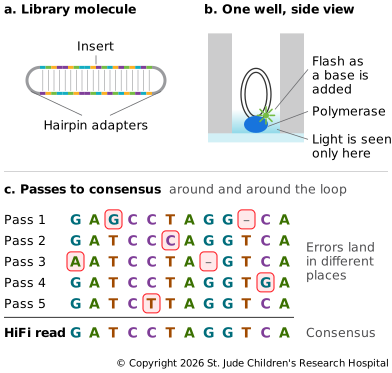
PacBio instruments watch a single polymerase copy a single molecule. The library is made by closing each double-stranded fragment into a loop with hairpin adapters on both ends. Each loop sits at the bottom of a tiny well, so small that the camera sees light only from the very bottom, where one polymerase works. As the polymerase adds each base, its dye gives off a flash, and the camera records the color.
Nothing loads from YouTube until you press play. Watch on YouTube
PacBio's animation of single-molecule sequencing and HiFi reads.
Because the molecule is a loop, the polymerase goes around it again and again, reading both strands many times. Any single pass has many errors, but they fall in different places on each pass, so software combines the passes into one consensus read. These HiFi reads are typically 10,000 to 20,000 bases long and about 99.8% accurate, on par with short reads (Wenger et al., 2019). PacBio's current instruments are the Revio, built for large projects, and the smaller benchtop Vega.
Nanopore Sequencing
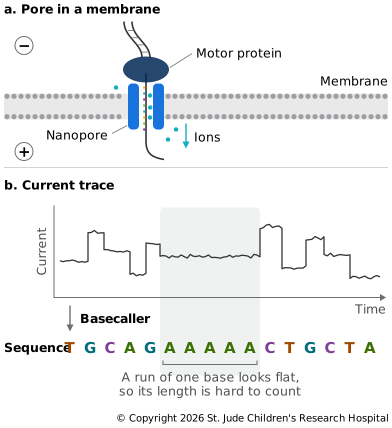
ONT instruments pull a single strand of DNA or RNA through a nanopore, a protein pore set in a membrane, with a voltage across it. The bases inside the pore partly block the flow of ions, and each combination of bases blocks it differently. The instrument records the current as the strand moves through, and software called a basecaller turns that changing current into a sequence.
Nothing loads from YouTube until you press play. Watch on YouTube
Oxford Nanopore's animation of a strand passing through a nanopore.
There is no fixed read length. A read lasts as long as the molecule, so the length depends on how gently the DNA was handled. With care, reads can be hundreds of thousands of bases long; one early study recorded a single read of 882,000 bases (Jain et al., 2018). With current chemistry, the most common read accuracy is about 99% (Sereika et al., 2022). The errors that remain are mostly small insertions and deletions in runs of the same base, because a run of identical bases looks much the same in the current as it passes through the pore.
Nanopore instruments range from the MinION, a pocket-sized device that plugs into a laptop, to the PromethION, which runs many flow cells at once. Reads stream out while the run is going, so analysis can start, or a run can be stopped, as soon as there is enough data. ONT can also read RNA directly, without copying it into cDNA first.
Short Reads or Long Reads?
| Short reads (Illumina) | PacBio HiFi | Oxford Nanopore | |
|---|---|---|---|
| Typical read length | 2 × 150 bases | 10,000–20,000 bases | Thousands to over 100,000 bases |
| Typical accuracy | About 99.9% | About 99.8% | About 99% |
| Main errors | Substitutions | Insertions and deletions | Insertions and deletions in runs of one base |
| Methylation | Needs a separate assay | Read directly | Read directly |
| Best for | Small variants, counting, large studies | Accurate genomes, structural variants, phasing | Very long reads, speed, portability |
Short reads cost less per base and remain the default for most work, including everything on the assay pages that follow. Long reads are chosen when the question needs them: repeats, structural variants, phasing or whole transcripts. Many projects use both.