RNA Sequencing (RNA-seq)
RNA-seq reads the RNA in a sample instead of the DNA. The genome is nearly the same in every cell of the body, but the RNA isn't: it shows which genes a cell is using, and how much, at the moment the sample was taken. RNA-seq is the most common way to measure gene expression, and it can also find gene fusions, splicing changes and variants in expressed genes.
What It Measures
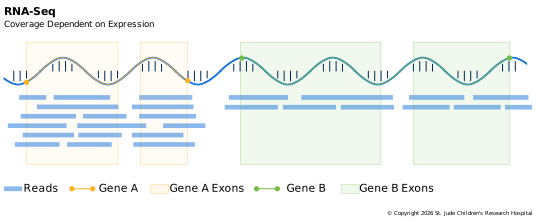
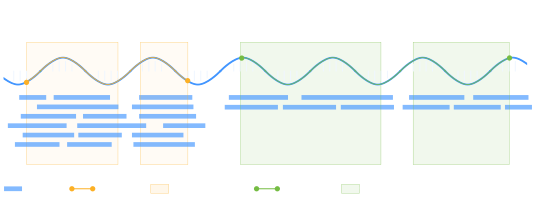
RNA-seq measures how many copies of each RNA were in the sample, along with their sequence. Since most reads come from mature mRNA, most fall on exons, and many cross from one exon to the next, which shows how the gene was spliced.
The result is always relative. More reads from a gene means more of its RNA compared with the rest of the sample, and the same gene can look very different in another tissue, at another time, or in a sample whose RNA started breaking down before it was frozen or fixed as FFPE.
RNA-seq is often used to learn which proteins a cell is making, but it measures RNA, and the two only loosely agree. In mammalian cells, mRNA levels explain only about 30 to 40% of the differences in protein levels between genes. The rest depends on how quickly each mRNA is translated and how long each protein lasts (Vogel and Marcotte, 2012). That said, RNA-seq is still a useful tool because it measures thousands of genes at once, and whether a gene's mRNA is present is generally a good sign of whether its protein is too (Vogel and Marcotte, 2012). It's the amounts that need care. Measuring proteins directly takes proteomics.
How the Library Is Made
Most of a cell's RNA isn't mRNA. Ribosomal RNA, part of the machinery that makes proteins, is typically more than 95% of the total (Kukurba and Montgomery, 2015). Sequencing it would waste nearly every read, so it's removed first, in one of two ways:
- Poly-A selection keeps only RNA with a poly-A tail, which most mRNAs have, by catching the tail on beads coated with strands of Ts. What's left is mostly mRNA from protein-coding genes, so this is often called mRNA-seq. RNAs without a tail are lost, such as the mRNAs for histones, circular RNAs and some long noncoding RNAs (Zhao et al., 2014). Many long noncoding RNAs do have a tail, though, and are kept (Derrien et al., 2012).
- Ribosomal RNA depletion removes ribosomal RNA and keeps everything else, so it's often called total RNA-seq. Along with mRNA, it keeps noncoding RNAs with or without a tail, circular RNAs, and RNA that hasn't been spliced yet, so some reads fall in introns (Zhao et al., 2014). It also works better on partly broken RNA, such as RNA from FFPE samples, where the tail may be cut off from the rest of the molecule.
Poly-A selection has long been the usual choice (Zhao et al., 2014), and it still uses reads more efficiently for protein-coding genes. In one comparison, 69% of bases from poly-A libraries fell on known transcripts, against 20 to 30% from ribosomal RNA depletion, where many reads fell in introns (Zhao et al., 2014). Ribosomal RNA depletion has become a popular alternative (Boone et al., 2018). Besides handling FFPE samples, it's the better choice for measuring noncoding RNAs (Kukurba and Montgomery, 2015), and more studies want them as their roles come to light. Very small RNAs, such as microRNAs, are usually sequenced with a separate method (Kukurba and Montgomery, 2015).
The remaining RNA is copied into cDNA by reverse transcriptase, and the cDNA is made into a library like any other (see Library Preparation).
Depth and Read Setup
RNA-seq depth is counted in reads. A fold depth such as "30x" wouldn't mean much, because each gene's coverage depends on how much it's expressed. ENCODE, a large project that set standards for many of these assays, asks for at least 30 million aligned reads or read pairs per sample (ENCODE). Reads are often paired-end, which helps with splicing and fusions. Finding rarely expressed genes or rare splice forms takes more reads.
Tradeoffs
Pros
RNA-seq finds things DNA sequencing can't, or finds them more easily:
- Expression. Which genes are on, which are off, and how that changes with disease or treatment.
- Fusions. A gene fusion makes RNA that starts in one gene and ends in another, and reads that span the join reveal it directly, even when the DNA breakpoint is buried deep in an intron.
- Splicing. Reads that cross from one exon to another show which exons were joined, including unusual joins caused by variants.
- Expressed variants. A variant in an expressed gene shows up in its reads, and the share of reads carrying it shows whether one copy is expressed more than the other.
Cons
- Genes that aren't expressed. A variant in a gene that's switched off in the sampled tissue is invisible.
- Whole transcripts. Short reads see pieces of each RNA, so which complete version a gene made has to be inferred. Long reads can read the whole molecule.
- Degraded samples. RNA breaks down quickly, so careful sample handling is even more important than for DNA (see Extraction and Quality Checks).
Example: Ph-like Leukemia
Some children and adults with acute lymphoblastic leukemia have cancer cells whose gene expression looks like that of leukemias driven by BCR-ABL1, but which don't carry BCR-ABL1. This group, called Ph-like ALL, has a poor outcome. A 2014 study looked closely at 154 patients with Ph-like ALL, most of them with RNA-seq (Roberts et al., 2014). RNA-seq alone found rearranged genes in 116 of the 136 patients it was used on.
Across all the methods, 91% of patients had a change that switched on a kinase, a protein that sends signals telling the cell to grow. Many were fusions, involving a short list of genes, including ABL1, ABL2, JAK2 and PDGFRB. In lab tests, leukemia cells with these changes responded to drugs that were already approved and that block the kinase each change had switched on. The authors called for clinical trials to test whether adding these drugs to treatment helps patients.