What Is Cancer?
There were close to 20 million new cases of cancer worldwide in 2022, and 9.7 million deaths from it (Bray et al., 2024). An estimated one in five people will develop cancer at some point in their lives. The word covers well over a hundred different diseases, and in the low to mid hundreds once they are split by the genetic changes that drive them. They start in different tissues and behave in very different ways. This page explains what those diseases have in common, how a cancer begins and how the main types are named. The rest of the chapter looks more closely at the genes involved and at how a tumor changes as it grows.
Cells That Stop Cooperating
A human body is built from trillions of cells, and nearly all of them carry the same genome. Living together takes restraint. A cell divides only when the body needs new cells, does the specialized job of its tissue and dies when it is damaged or no longer needed. Neighboring cells, chemical signals and the cell's own genes enforce these rules.
Cancer is a disease in which some of the body's cells grow uncontrollably and spread to other parts of the body (National Cancer Institute). Biologists who study cancer across many species describe it as a breakdown of cooperation (Aktipis et al., 2015). Cancer cells divide when they should stop, avoid the death that would remove them, abandon the specialized work of their tissue, take more than their share of resources and damage the environment around them. The next page breaks these abilities down into the hallmarks of cancer.
Tumors
Extra cells often build up into a lump of tissue called a tumor. Not every tumor is cancer.
A benign tumor grows in place. It does not invade nearby tissue or spread, and once removed it usually does not grow back. Benign tumors can still be dangerous when they grow large or press on something vital, as some brain tumors do.
A malignant tumor is cancer. Its cells invade the tissue around them, and some can break away, travel through the blood or lymph system and start new tumors elsewhere in the body. This spread is called metastasis, and most deaths from cancer are caused by cancer that has spread. A tumor that grows from cells that have spread keeps the name of the original, or primary, tumor. Breast cancer that spreads to the lung is metastatic breast cancer, and its cells still look like breast cells under a microscope.
Some changes come before cancer. In hyperplasia, cells divide faster than normal and build up, but they look normal. In dysplasia, the extra cells also look abnormal. Carcinoma in situ is a group of abnormal cells that has not invaded nearby tissue. It is sometimes called stage 0 cancer, but none of these changes is cancer. Some can become cancer, so they are often watched or treated (National Cancer Institute).
Not every cancer forms a lump. Leukemias, cancers of the blood-forming tissue in the bone marrow, fill the blood and bone marrow with abnormal white blood cells instead.
How Cancer Starts
Cancer is a genetic disease. It is caused by changes to the genes that control how cells behave, especially how they grow and divide. Some of these changes are inherited from a parent. Most arise during a person's lifetime, either from errors made when a cell copies its DNA before dividing or from DNA damage caused by exposures such as the chemicals in tobacco smoke and ultraviolet light from the sun. The body normally removes cells with damaged DNA, but it gets worse at this with age. Age is the single most important risk factor for cancer, and the median age at diagnosis in the United States is 67 (National Cancer Institute).
A single change is rarely enough. Peter Nowell proposed in 1976 that most tumors arise from one cell, and that a tumor progresses as its cells acquire new changes and the most aggressive ones are selected (Nowell, 1976). A cell gains a change that lets it divide a little more often than its neighbors, so its descendants slowly outnumber them. One of those descendants gains a second change and outgrows the rest, and the process repeats. In some tumors, cells eventually gain the ability to invade. Each new change of this kind sets off another wave of growth, and the tumor gets larger and more disordered with each one (Vogelstein and Kinzler, 1993; Greaves and Maley, 2012).
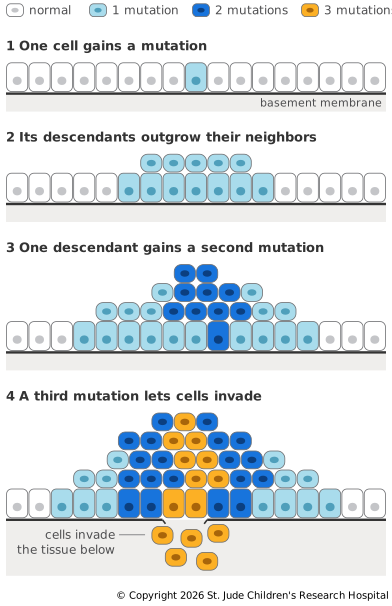
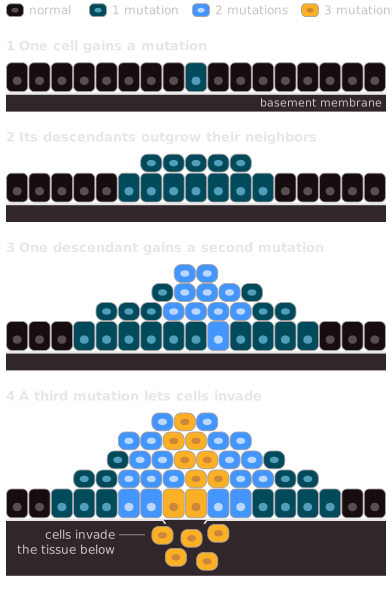
The changes that push a cell along this path are called driver mutations. Across more than 7,600 tumors of 29 types, the average tumor carried about four driver mutations that change a single base in a protein-coding gene. Thyroid and testicular cancers averaged fewer than one, and colorectal and endometrial cancers more than ten (Martincorena et al., 2017). Those counts leave out larger changes, such as gained or lost chromosome segments, which can drive cancer too. Most of the other mutations in a tumor are passengers that came along for the ride. Oncogenes and Tumor Suppressors explains which genes the drivers hit, and How Tumors Evolve follows the descendants of that first cell further.
Because every tumor follows its own path, each one carries its own combination of changes, and cells within the same tumor can differ from one another. Two patients with the same type of cancer can have tumors that are genetically very different.
Types of Cancer
Cancers are usually named for the organ or tissue where they start, so lung cancer starts in the lung even if it later spreads to the brain. Worldwide, the most commonly diagnosed cancers are lung, female breast, colorectal, prostate and stomach cancers (Bray et al., 2024).
Cancers are also grouped by the kind of cell they start in. The main groups are:
- Carcinomas start in epithelial cells, which line the inside and outside surfaces of the body. They are the most common type of cancer, and most breast, colon, lung and prostate cancers are carcinomas.
- Sarcomas start in bone and in soft tissues such as muscle, fat and blood vessels. Osteosarcoma is the most common cancer of bone.
- Leukemias start in the blood-forming tissue of the bone marrow. The four common types are acute lymphoblastic, acute myeloid, chronic lymphocytic and chronic myeloid leukemia.
- Lymphomas start in lymphocytes, the T cells and B cells of the immune system. The two main types are Hodgkin and non-Hodgkin lymphoma.
- Multiple myeloma starts in plasma cells, the immune cells that make antibodies.
- Melanoma starts in melanocytes, the cells that make the pigment that colors skin. Most melanomas form on the skin.
- Brain and spinal cord tumors are named for the cell they start in and where in the nervous system they form.
These groups are only the first level. Within each, cancers are split by the exact cell type and, more and more, by the driver changes they carry. The World Health Organization now names some brain tumors by their driver, such as IDH-mutant astrocytoma (Louis et al., 2021). Experts don't always agree on where the lines fall. In 2022, two expert groups published separate classifications of myeloid leukemias that differ in several places (Khoury et al., 2022; Arber et al., 2022). That is why one source counts more than 100 types of cancer (National Cancer Institute) and another more than 200 (Cancer Research UK).
Cancer in Children
Cancer in children is rare. Only about 1% of cancers in the United States are diagnosed in people under 20 (National Cancer Institute). The most common types are different from those in adults. Leukemias come first, followed by brain and other central nervous system tumors and then lymphomas (National Cancer Institute). Carcinomas, so common in adults, are much less common.
The genomes of childhood cancers look different too. A study of 1,699 childhood leukemias and solid tumors found lower rates of single-base mutations than in common adult cancers. Of the 142 driver genes it identified, only 45% matched those found in adult cancers, and most driver events were copy number changes and structural variants rather than changes to single bases (Ma et al., 2018). Some children also carry a germline variant, present in every cell of the body, that raises their risk. Such variants can be inherited from a parent or arise new in the child. In a second study of 961 tumors from children, adolescents and young adults, 7–8% of the patients carried one that clearly predisposed them to cancer (Gröbner et al., 2018). Inherited Risk returns to these.
Up Next
Cancer cells break the rules that let trillions of cells live together. Hallmarks of Cancer lists the abilities a cell needs to break them.